Click Here For Free Blog Backgrounds!!!
Blogaholic Designs

Pages

Showing posts with label multiplication. Show all posts

Saturday, December 10, 2016

PARCC 2016 Released Math Items: "161 is 7 times as many as 23"

Wouldn't it be nice if your school district had software available to you so you could create math tests for your students using the same computer testing format as the PARCC test? 
This PARCC question involves dragging and dropping numbers and symbols to show an equation.


Since we don't all have that type of software available, this worksheet can be used to make students 
aware of what they must do. 
I know that the phrase, "28 is 4 times as many as 7," is correct but it still sounds so foreign, even to me, because we don't talk about equations as comparisons very often.
Think of this: 
4 X 7 = 28 can be read as a comparison between the numbers in the equation. It helps to remember that the equal sign really means "is the same as."
 * 4 X 7 is the same as 28
* 28 is the same as 4 X 7
*28 is the same as 4 sets of 7
* 28 is 4 times as many as 7


Smiles,
Deborah 

Monday, October 3, 2016

Multiplication Models: Teaching by Activating Prior Knowledge

 Activating Prior Knowledge in Mathematics
I've been tutoring a 4th Grade Student who is being taught math using the "Math Expressions" program by Houghton Mifflin Harcourt.   Chapter 2 explores ways to draw multiplication using area of rectangles, using Expanded Notation, using Algebraic Notation, using the Distributive Property, the Shortcut method, and the Place Value Section Method.  YIKES, each page is a different method!!
To help her, I've decided to concentrate on ONLY seven problems featuring - 1 digit X 2 digit problems.   

That way she can use her schema to make connections between the different methods, instead of calculating new problems for each method.

What Is Schema?
Call it schema, relevant background knowledge, prior knowledge, or just plain experience, when students make connections to the mathematics they are learning, their understanding increases. Good mathematicians constantly try to make sense out of what they are learning by seeing how it fits with what they already know.  Ellin Oliver Keene and Susan Zimmerman in Mosaic of Thought (1997).

To begin with we activated her basic facts background knowledge by completing these expressions. This can serve as math bank of facts while working on the calculation in the lessons to follow. These same facts will be needed throughout each method.  As I work with her, it isn't about knowing your facts... but about understanding the deeper meaning about the impact of the place value of the digit when you multiply multi-digit numbers. 


I had pre-cut the following 4 pages into number expression strips, area model drawings, and corresponding real life word problems.


First, I read aloud the word problem about the bags of apples being donated to the food pantry.  I handed her all the math expression strips and asked her to find the strip showing the expression that could be used to solve this problem.  She handed me the " 6 X 14" strip.

I asked her to explain her thinking about her choice.  She did so. 
She has already covered expanded form of numbers and quickly defined 14 as 10 + 4.  I then explained that we were going to show her thinking  using an area model of square unit by using the number 14 in that expanded form.  
While "thinking out-loud," I chose these 2 area models.  I explained that each square represents an apple and quickly sketched in some apples in some of the square units on the model. 

To record our thinking, I glued the strip containing the math expression and the area model onto her paper.


The above page was placed in a clear plastic worksheet protector, and I completed my calculations, using a dry erase marker, while "thinking out-loud" and explained the WHY behind my calculations. I recorded my calculations next to the model on her large sheet of paper.

With my assistance, she completed the next six word problems in the same way. 


Using the Place Value Model with a Quick Rectangle
Sketching the area model in a rectangular format was added next, and how to calculate the multiplication was done of the second half of the sheet in a clear plastic worksheet protector.  We activated her schema and discussed  the connections between the area model from yesterday, and the quicker sketch that represented the same thinking.

Moving on to the distributive property model..... The area model that we had already completed helped her understand how 6 X 14 could be redistributed into 6 X 10 and 6 X 4, while not changing the amount in any way.

The new learning came from explaining the use of " (   )" to record our thinking. She found it funny that the + sign was stuck there in the middle of all those (  )'s. With a bit of help, she wrote down all the math equations for the SAME 6 problems.
Let's make it a bit more challenging... 
and work on the next method- Algebraic Notation Method and substitute a dot for the previously used X symbol. 


  The beauty of continuing to glue our thinking onto the same piece of paper really was like magic.  She used her schema to see the slight change in the equation and plunged on to calculate the SAME 6 problems again using this method. "The word Algebra kind of scared me, but it's really not that big of a difference is it?" she said.

From My Teacher Pay Teacher Store
If you like this method of instruction that I've described in this post, all sheets can be purchased through my Teachers Pay Teachers Store for only $2.00.  They took hours to create.  

The Shortcut Method was added once the student understood the place value behind the calculations.

Smiles,
Deborah


Wednesday, January 6, 2016

Understanding More About Multiplication Using "LearnZillions", Lesson 3

First, as my 3rd Grade Student continues to understand more about multiplication,  the lesson we did today begins by reviewing what we already know... our schema.

LearnZillions  Internet website has a great video lesson based on the Common Core Mathematics Standard 3.0A.A.1
Interpret products of whole numbers using pictures, arrays, and number lines.

So I have the 3rd Grader watch this video: https://learnzillion.com/lesson_plans/4765-interpret-products-using-arrays

Interpret Products by Using Arrays
I believe it summarizes what we have learned about multiplication so far:
1.  Another way to think about this equations 6 X 3 = 18 is Six Groups of Three is the same as 18.

2.  It reviews this information using multiplication word problems.
3.  It reviews the vocabulary of multiplication: number in each group, number of groups, factor, product. 

There are also short video's on interpreting products by using pictures and number lines too. 

My first choice on the video's that I will have students use are usually the Building Block Standards because the the correlation to the Common Core Mathematics Standards. 

I also like the Grade Level Navigator Pages that tell you what video lessons support the Common Core Standards for each grade level.  There are clickable links to those lessons from the pages.


As our lesson continues, we play a short game of Dominoes Multiplication.  It's so easy to do...just use the dominoes that show a 6 on one side of a domino ( 6 X's and the related fact)
 or you can use the free cards from the  

 Sparklebox website: http://www.sparklebox.co.uk/previews/7651-7675/sb7675-numbers-and-dots-dominoes.html#.Vo1HCFLfvd4 


Turn all the dominoes facedown on the table. At your turn, say the fact aloud and provide the correct quotient. If you are correct, you keep the domino. If you incorrect, give it to the other player. Player with the most dominoes, when all the dominoes are used, is the winner.  Easy Peasy!

Smiles,
Deborah


Monday, January 4, 2016

Button Candies Array Cards and the Commutative Property, Lesson 2

The next lesson continues to explore  the
 3 times button candy array cards the 3rd Grader and I 
 made in the last post. (view post)

 
 In preparation for our lesson, I attached a new card to each of the previously made array cards. My plan is to work with the array cards and their related facts
( the Commutative Property of Multiplication).


I created this worksheet.
First, we skipped counted by threes and sixes.
Next, we cut out the candy button arrays for 3 X 6  and 6 X 3, being careful to trim closely to the edge of the buttons.  Before gluing the arrays to the paper, I ask her if she noticed anything the same about the two arrays?
"Yes, I noticed that they are the same size."
"How can you tell?" I asked.
"Well, if you lay one on top of the other you can see they are the same size."
"Yes, they are the same size or we could say they are conquent in shape and contain the same area."


3 X 6 array on top of 6 X 3 array

We summarized our thoughts by filling in the Venn Diagram in the "how they are the same".
We then glued the arrays on the worksheet, and I asked her why she glued them in different directions on the worksheet.
We summarized the conversation by filling in the areas on the "how they are different " on the Venn Diagram.  We also added the corresponding multiplication equation and the repeated addition equation  to each area. We noted that both equations contained the same factors and the same product.


Lastly, the student cut out and glued (on the blue side of the card) the new arrays for each of the related fact multiplication equations.

More lessons on this same subject in the next post....
Smiles,
Deborah


Saturday, January 2, 2016

Button Candies To Teach an Understanding of the Meaning of Multiplication

I've been working with a 3rd Grader to develop an understanding of the meanings of multiplication and division of whole numbers through activities and problems involving equal-sized groups, arrays, and area model.  

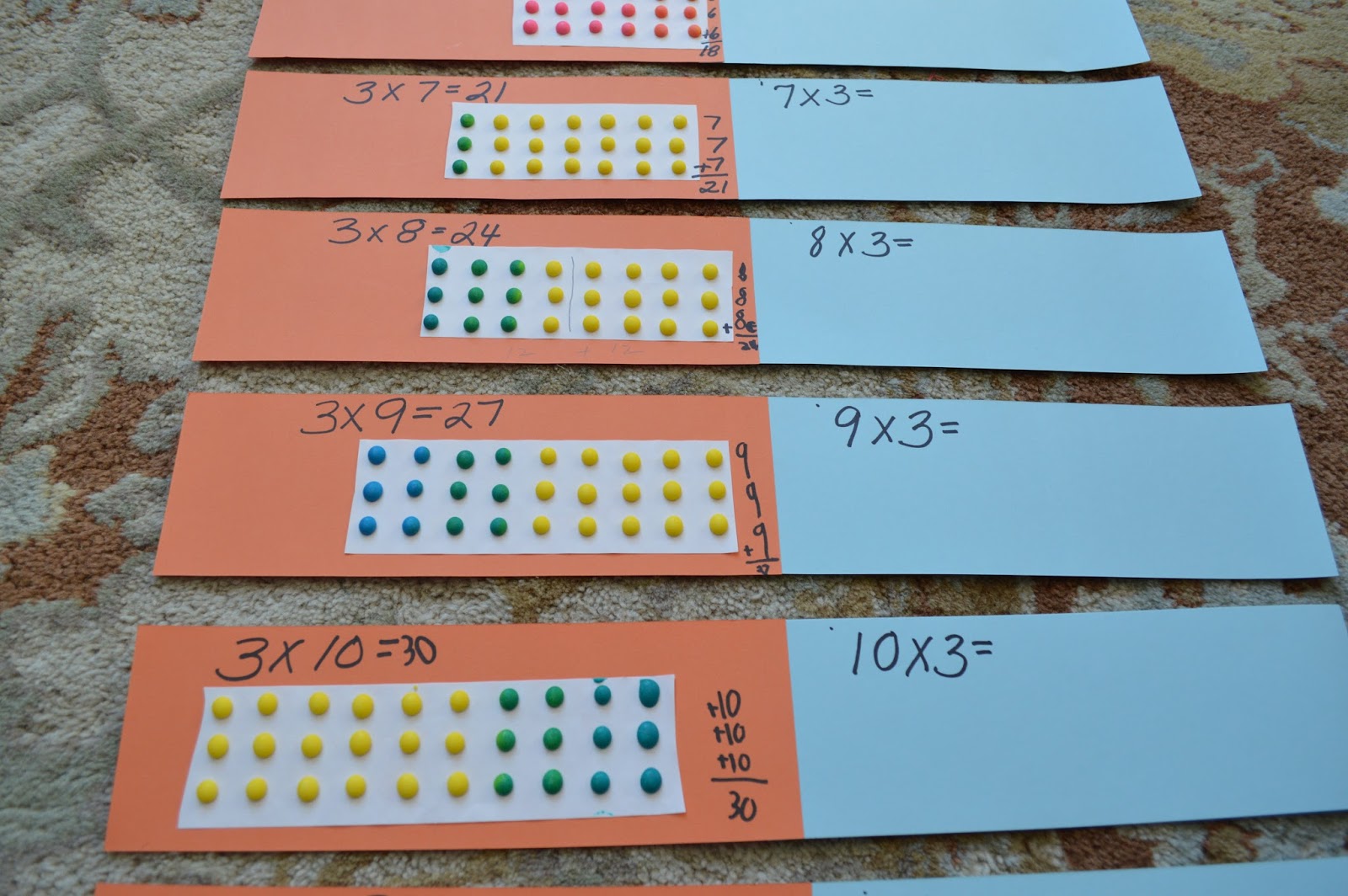
Today we created these flashcards together that illustrate the meaning of the equation.

I like to think of the equation as a sentence. 
 The sentence says, " Three groups of seven are the same as twenty-one."  

When you read the equation in this way, it starts making sense... not just a multiplication fact that you need to memorize.

Notice that we added more meaning by showing the relationship to repeated addition on the left-hand side of the card.
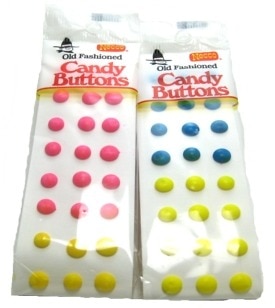
We used this candies to create the arrays.  The 3rd Grader said that it was the yummiest math lesson ever!

When we created the array for the equation 
3 X 0 = 0
I thought the final model really showed the concept:
We peeled the candy buttons and left a residue that showed 
a value of nothing.
Interestingly, when I gave this student a screening test for her multiplication concepts, it showed that she did not understand the concept of multiplying a factor by zero. 
Now I feel that she does understand

The Multiplication Property of Zero

Future lessons will use the cards that we created. 

What do you think of my idea? 

Please share your ideas in the comment section of this post or share a link to your blog in which you are discussing teaching understanding.

Smiles, 

Deborah


Tuesday, April 10, 2012

Strategies to Remember Multiplication Facts


This video explains the strategy that students can use to remember the following multiplication facts:
6 X 2 =            6 X 4 =          6 X 6 =              6 X 8 =


I designed some flashcards that students can use to practice the strategy of using this pattern to HELP them  remember the product. 

To


Deborah Devine

Wednesday, December 28, 2011

Looking for Patterns in Multiplication Facts

I was thinking about other patterns that I could make students aware of when they are studying multiples of a certain number and I starting looking at the multiples of 5.
I have always pointed out that the products end with either a 5 or a 0.
As I looked closer I noticed :
  • that the numbers that end with 5 are the products of 5 and an odd number
  • that the numbers that end with 0 are the products of 5 and an even number

Giving students an opportunity to look at patterns of multiples of a particular number on a 100's chart can expand student's thinking.

When studing their multiplication tables have students color code the number chart for math factors and multiplication tables.

They can print a different chart out for each number set, or work off of one chart. For example, color all multiples of three the same color. Do students see a pattern? Then color all multiples of four a different color from multiples of three.

The students wouldn't have to print the chart, just write their reflections about what they noticed.

(Note: If students make a mistake while coloring their number pattern, they can select the white crayon to color the mistake and it will reset the square to a blank color.)

I'll have to add that to my Multiplication Strategy Flip Book.


Deborah Devine

Monday, December 19, 2011

Order of Teaching the Multiplication Facts


Do you teach the multiplication tables in order of 1- 12? I would suggest teaching one easy one set of facts like 1's and linking it to one more difficult like 3's. Then easy, difficult, easy, difficult.

 I think of it as "build my confidence and now let's work a bit."
Also think about what facts go together... like 2's and 4's, and 3's and 6"s.

Deborah Devine

Saturday, December 17, 2011

PowerPoint Slide Show For Parents to Help Their Children with Multiplication Facts

This PowerPoint presentation was created to use with parents of students from 3rd - 6th Grade. The purpose of the presentation was to involve parents in helping their children learn their multiplication facts. 

 According to the new Mathematics Common Core Learning Standards, students are to know their multiplication facts FLUENTLY by the end of 3rd Grade.

I didn't know how to download a PowerPoint presentation to my blog, so I made a JPEG of each slide. Hopefully this will be of use to you.  I will also make the slides available in my Google Docs File as a PDF file. Click HERE to go to the Google Doc file.


Deborah Devine
Related Posts Plugin for WordPress, Blogger...