Click Here For Free Blog Backgrounds!!!
Blogaholic Designs

Pages

Friday, October 25, 2013

Money and the November Calendar Routine


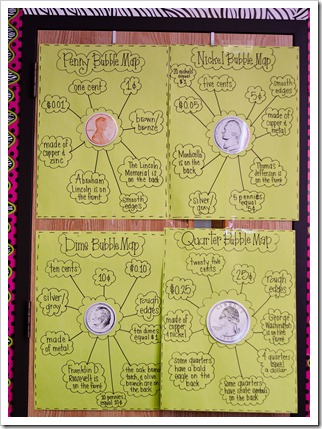
Here is my suggestion for calendar time for the month of November:  Create a pattern of coins. 
 
As each new coin is introduced, a new piece of information can be discuss about that particular coin. I used plastic money and just double-stick taped it to the laminated calendar.


As different information is discussed about each coin, an anchor chart can be created like this one from First Grade Parade blog:
valentinesday5

So what do you think about my idea?  Leave a comment...

Thursday, October 24, 2013

Even and Odd

Why do many teachers only teach examples of even and odd numbers, and not properties of even and odd numbers?

What do I mean?  Well, this is what I discussed with a 1st Grade Student when the only thing she could tell me about even and odd numbers was:
Even is 2, 4, 6, 8, and 10
Odd is 1, 3, 5, 7, and 9
And that's all....

First, we built models of the numbers 1 through 10

Then I asked her 2 separate the models into 2 groups that were alike in some way.

This is how she separated the models.  When I asked her what she noticed about the two groups, and she noted this on the models:

"This group doesn't have a partner for each part of the number
and this group does have a partner.  See, how I circled the partners."

Then we discussed how certain numbers can be divided into groups of two, and that we call those numbers Even Numbers.

We went on to talk about odd numbers too.  Since she is in a dual language class, she also wanted to write the Spanish word for even/par and odd/impar on the model.

Next, I asked her to now tell me what she knows about even and odd numbers and she wrote this:
I found it interesting that she put an arrow after the numbers and said "and on and on."  (That put a smile on my face.)

So we talked about how you look at the "on and on numbers" in the ones place to see if they are even numbers or odd numbers. 

I evaluated her knowledge by quickly using a set of teen number cards.
and asked her to classify them as even or odd numbers. 

She was correct, and we even checked our first answer to
 prove that she was correct.

Deborah


Sunday, October 6, 2013

"Because"

When I taught 2nd, 3rd, and even 4th Grade Classes, I was always surprised how many students could not spell the word "because."


SO..... how about changing the computer log-in password that your students must use to  "because." This just might be the perfect way to make sure all of your students learn the correct spelling of this important word. What do you think about that idea?

Deborah

Wednesday, October 2, 2013

Developing Number Sense: Plus 1 or 2


   In his book, "Teaching Student-Centered Mathematics," John Van de Walle states "When children count, they have no reason to reflect on the way one number is related to another. The goal is only to match number words with objects until they reach the end of the count. To learn that 6 and 8 are related by the twin relationships of "two more than" and "two less than" requires reflection on these ideas within tasks that permit counting. Counting on  (or back) one or two counts is a useful tool in constructing these ideas."
 
Of course, the development of this skill is also quite useful when adding 2 + 7, or 1 + 9.
 
 There are 36 addition facts that include the addend of 1 or 2. 
 
So I hope this game will help you. 
 Click HERE to take you to my Google Drive where you can download the game board.
 
Deborah


Friday, September 20, 2013

Color Coding 100's Charts

Have you begun to use the 100's chart with your class this year? 

Remember to color code the return sweeps like this:
 
Why?  I personally have difficulty tracking lines of text, and I know there are students that have the same problem.  It's also hard to learn to visually sweep your eyes from 40 to 41. 
 
A good independent activity is to have students color code the 100's chart that they use on the back cover of their Math Journal also.
 
Deborah. 

Tuesday, September 3, 2013

Let's Collect Some Data for Grades 1 or Multigrade 1/2

Today, my granddaughter came home from school and said, "I want to collect some data."... and of course my heart rate increased...and I said I had an idea!

I just received the book, "Spookley the Square Pumpkin Counting and Colors" by Joe Troiano.

 It isn't a deep, thoughtful book, but the reading level was just perfect for my First Grader.


I suggested that we create a chart in Word, print it out, and use tally marks to gather data about the number of pumpkins and their colors that were shown in the book.

First, let's say that First Graders can do amazing things. I set up the 2 column chart and labeled the two categories.  When it came time to list the color possibilities, My First Grader used the back portion of the book to obtain the correct spelling of each color word, and type it into the chart.  She needed a little help in learning about how to tab through a chart, but that's all!.
Here's what the completed chart looked like:

Next, we printed the page, and used tally marks to collect the data of the number of pumpkins in the book for each color. 

Here is a link to share the chart with you:
https://docs.google.com/file/d/0B6F30lEu7WXlV0g5S1JxdGt5bG8/edit?usp=sharing

In your classroom, this chart might be completed in a small group of 3 or 4 students working together. For those teachers using Everyday Math, it works well following Lesson 1.7 Recording Tally Counts, in the First Grade book.
 It could also be used in Multigrade 1/2 Classroom as an activity during Guided Math groups.


Lastly, let me thank that First Grade Teacher that inspired my granddaughter to "collect some data." :)

Deborah


Monday, September 2, 2013

Exploring Dice-Dot Patterns

The ability to quickly recognize the patterns on a die without counting each dot is important for young children.
 So today I played a game with a First Grader in which we each had 20 counters and 1 die.

The players take turns rolling the die and picking up as many counters as indicated on the die until all of the counters have been picked up. To pick up the last counter, the number on the die must match the number of counters remaining.  The first player that picks up (or slides the counters to the side of their pile) all their 20 counters is the winner.

While playing this game it is easy for the teacher to evaluate:
1) Can the child recognize the pattern on the die at a glance, or is it necessary for the child to count each dot before knowing the amount indicated on the die?
2) When counting their counters do they have one-to-one correspondence, and do they count using the correct sequence?

When we played the game the second time, I counted out my counters by two's instead of by ones. The First Grader followed my lead by counting her counters by two's also. So I learned something new about her again... that not only could she count by two's but she had the ability to utilize that pattern when picking up (or sliding over) her counters. To count out the number of 5, she slid the counters in this way:  2,2,1.

EXTENDING THE LESSON


I told the student that I wanted to know what she already knew about the patterns on dice.  I gave her 6 post-it notes and asked her to draw the pattern for each number on the post-it notes.  This is what she drew:
 
When I looked at  the post-it notes I could tell that the student had internalized the 6 patterns on the die, and could  tell you immediately without counting the value of each pattern.
 
If I was saving evidence of learning, I could save the six post-it notes, or a photo of her work.
 
Deborah


Related Posts Plugin for WordPress, Blogger...