Click Here For Free Blog Backgrounds!!!
Blogaholic Designs

Pages

Showing posts with label fractions. Show all posts

Tuesday, March 7, 2017

Grade K or 1st: Fraction Pizza Center

Here is an idea for a quick math center. 
 How do you cut these pizzas to share them equally? 
They are fun to make out of play-dough also in a kitchen center.
My granddaughter had 2 friends over for a sleep-over and we made individual pizzas.  So each child cut their pizza with a fun pizza cutter utensil to show how they would share their pizza with 2, 3, and 4 friends.  
By the way, my granddaughters laugh when I ask them to do things like this because they know I love sharing math with them.

Smiles,
Deborah

Thursday, December 15, 2016

Equivalent Fraction Games from Illuninations


Have you seen the Equivalent Fraction tool on Illuminations. Here is a link to this tool.

 Your students can create equivalent fractions by dividing and shading squares or circles, and matching each fraction to its location on the number line.

It's a fun way to see representations of equivalent fractions without a paper and pencil activity.  There is an iTunes app too.

Here's the gameboard from the Fraction Game.
This applet allows students to individually practice working with relationships among fractions and ways of combining fractions.

Fun and Free!
Smiles,
Deborah 

Saturday, December 19, 2015

When You Can't Make Connections in Math

Recently, I visited Mexico for a short holiday.  While in Mexico, I experienced that feeling of not comprehending connections about money values.  When I would see a price in a menu, I had no connection to what that amount would be in American money.
I couldn't answer simple questions like:

Should I buy that ceramic glass... is it worth 320 pesos? 
Is this daily rate for my hotel room reasonable and in my budget?
Did that person give me the correct change?
How much is each person's bill at the restaurant and how much should I tip the server?


It was driving me crazy!!!
So I made up a simple chart for my family based on the current exchange rate that looked somewhat like this:
US            Mexico
$1              16
$5               80
$10            160
$15             240
$20             320
ETC.
I also wrote the American value on the end of each Mexican Bill until I started internalizing their value.  Suddenly I felt like I was in control. I had NUMBER SENSE again.

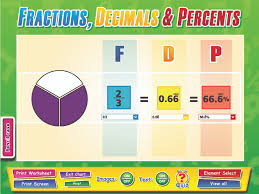
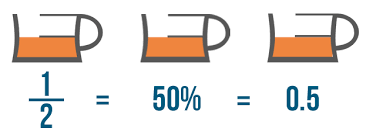
Do you have students in your class that can't make connections between mathematical concepts like fractions, percents, and decimals?    Please help them make those connections with concrete experiences, games, and charts.
Image result for percent, fractions, and decimalsImage result for percent, fractions, and decimals  Image result for percent, fractions, and decimalsImage result for percent, fractions, and decimals   
It feels terrible when you just don't have any connections or background knowledge to help you understand....

Smiles,
Deborah

Friday, March 20, 2015

Fraction Progress: Referring to the Same Whole

I've been doing some personal professional development about the fraction progression in the Common Core Standards.  

I was thinking about this standard:
 
CCSS.Math.Content.3.NF.A.3.d
Compare two fractions with the same numerator or the same denominator by reasoning about their size. Recognize that comparisons are valid only when the two fractions refer to the same whole. Record the results of comparisons with the symbols >, =, or <, and justify the conclusions, e.g., by using a visual fraction model.


When I came upon this task at Illustrative Mathematics.
 
If you were to choose the two pictures that best compares 2/3 and 2/5, which two illustrations would you choose?


•Your first reaction would be that students could choose either illustration 3 or 4 to represent 2/3.  That is true, but why must you select illustrations 4 and 5 together?


•This question highlights the fact that in order to compare two fractions, they must refer to the same whole. 
Do we spend enough time on the fact that both fractions must refer to the same wholes?
     When we use pre-made worksheets that compare fractions, they usually have a pre-drawn "Whole."  


Using this task from Illustrative Mathematics, in a small group format, could lead to an amazing discussion of the importance of the "same whole."

Here at home, I think I will give my soon-to-be Third Grader 
a cookie like this and ask her to share 1/2 of the cookie
 with me. 

 
I will promise to share 1/2 of my (unseen ) cookie with her.

My cookie will look like this:
What do you think her reaction will be?  Will our discussion lead to the importance of the "same whole?"
P.S.  If I had a multi-grade 2/3 classroom, would this still be an appropriate lesson, using cookies instead of a worksheet?  What questions would I ask of a 2nd Grader versus a 3rd Grader? 
Smiles,
Deborah

Tuesday, August 12, 2014

Teaching Understanding in Math

Now that we are focusing on certain mathematical common core standards instead of "going through our book," how exactly do you teach for that deeper understanding.  I like using real examples to explain my thinking, so let's think about teaching about dividing fractions. 

That's a scary proposition for most teachers!

What if you began the unit with an anchor chart that does not show a procedure step-by-step but instead looks like this:
During the whole group discussion the anchor chart changes like this:


The next day, in partners, students answer this question concerning if my answer is reasonable or not.
 or
 "Does this answer make sense?"


How do you teach understanding instead of procedure?

Please share your ideas in the comment section of this post or share a link to your blog in which you are discussing teaching understanding.

Smiles,
Deborah

Tuesday, January 3, 2012

Color Coded Fraction Comparison Chart


This color coded fraction comparison chart would be a valuable resource to a student that has difficulty tracking information across a table.  Using a ruler or two strips of heavy paper vertically to compare the fractions would also be an effective strategy to use this chart.  If you don’t want to copy the chart using colored ink, another idea is to use a strip of lightly colored acetate film to help track across the chart.
 How do you recognize those students that could use this differentiating resource?
Look for students that use their finger to track the information, or use a ruler under the line of information, or seem overwhelmed when reading charts of this type.
I personally have difficulty in tracking information across a page, and through experimenting I have found these adaptations to be of value to me.

Click here for a copy of the Fraction Bars.

Deborah Devine

Friday, November 4, 2011

"Fraction/Decimal/Percent Card Deck Games from Everyday Math

The Everyday Math  "Fraction/Decimal/Percent Card Deck"  contains cards showing 18 different fractions, decimals, and percents. The fraction, decimals, and percents are equivalent to each other. Even though Everyday Math created an activity booklet to go along with the cards, I find that many teachers are not aware of the suggested activities because they are not in the Teacher Resource Guide manual, or don't play them because there are no formal game boards to accompany the suggestions.

So I am planning to host a workshop in my district to play 10 New Games that use the Fraction/Decimal/Percent Card Deck  in January 2012.  I've been busy creating game boards or playing mats for the games, and I thought I would share some of them with you in a series of  posts.

The first game is called "Bar Graph Addition" and the skills covered in the game are estimating the sums of fractions and recording data on a bar graph. This game is worth the use of class time to play the game as many students don't understand fractions very well. I love this informal format and the fact that you record the sums according to 3 different categories: Sums 1/3 or less, sums between 1/3 and 2/3, and sums 2/3 or greater.

I made this game board to accompany the game, and you only use the fractions cards contained in the deck.  To make it easier for the teacher, the directions to the game are located on the game board at the bottom.

Click on the document to download it.
Deborah
Related Posts Plugin for WordPress, Blogger...