Click Here For Free Blog Backgrounds!!!
Blogaholic Designs

Pages

Showing posts with label addition. Show all posts

Sunday, November 2, 2014

Recess Learning with Campaign Signs

I know that you seen many outdoor campaign posters like this with the upcoming election:


After the election, all these signs are removed and thrown away, 
so make use of this valuable resource and create this activity.


During lunch recess time, work with you lunchroom supervisor or a  parent volunteer to reinforce learning that is happening in your classroom.
First, glue a piece of paper over the front and back of the sign.  Write or glue on a written question and answer on the sign. For this example, let's imagine that your students have been studying addition doubles plus one or two.


Student begins at the start and softly dribbles the ball  to the first sign. The student calls out the answer, then waits
 to see if the answer is correct.

 A student standing next to the sign tells the student
 if they are correct.
  If they are correct,
then they softly kick the ball through the legs of the sign.
Student continues through all signs in the order
 specified by the teacher. 
great fun + exercise + learning = a great activity 

Leave a comment and let me know what you think of my idea.  

Smiles,
Deborah Devine

Wednesday, October 2, 2013

Developing Number Sense: Plus 1 or 2


   In his book, "Teaching Student-Centered Mathematics," John Van de Walle states "When children count, they have no reason to reflect on the way one number is related to another. The goal is only to match number words with objects until they reach the end of the count. To learn that 6 and 8 are related by the twin relationships of "two more than" and "two less than" requires reflection on these ideas within tasks that permit counting. Counting on  (or back) one or two counts is a useful tool in constructing these ideas."
 
Of course, the development of this skill is also quite useful when adding 2 + 7, or 1 + 9.
 
 There are 36 addition facts that include the addend of 1 or 2. 
 
So I hope this game will help you. 
 Click HERE to take you to my Google Drive where you can download the game board.
 
Deborah


Monday, September 10, 2012

Fluently Add Within 5 by Creating Awareness of Different Combinations that Equal a Number


How do you make the connection between a  representational model (5 or 10 frame) and how that same information is written in an abstract equation ( 2 + 1 = 3)?


Using the 2 color counters, the student explores different  combinations of red and yellow counters that equal 3.
 If desired , the student can  use the included number cards and create the equation directly under the 5-frame model.  2 + 1 = 3


Next, students fill-in-the-missing-digit on the equations written on the watch.


Tape the watch to the child’s wrist. Throughout the day, ask oral questions that review combinations of numbers that add up to the digits  1-5. 
“ 2 plus what number equals 3?” 
“If I have 1, how many more would I add to the 1 to make 3 in all?


Deborah


Monday, March 19, 2012

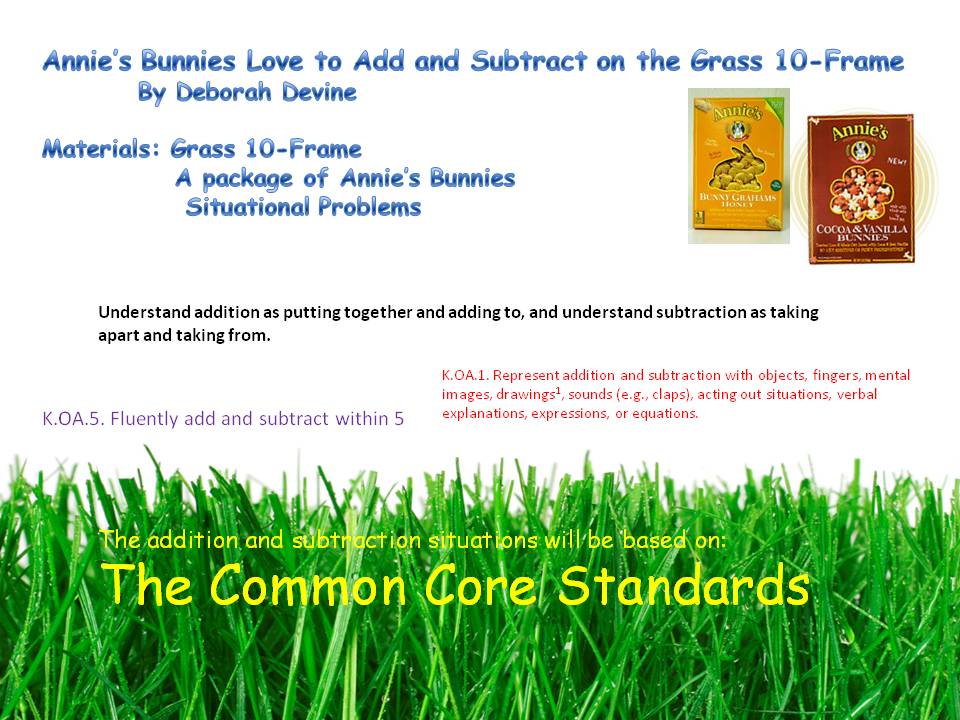
Annie's Bunnies Love to Add and Subtract on a Grass-lined 10 Frame

I made it so much better!  AND....it's all based on the Common Core Mathematical Standards for Operations and Algebraic Thinking.
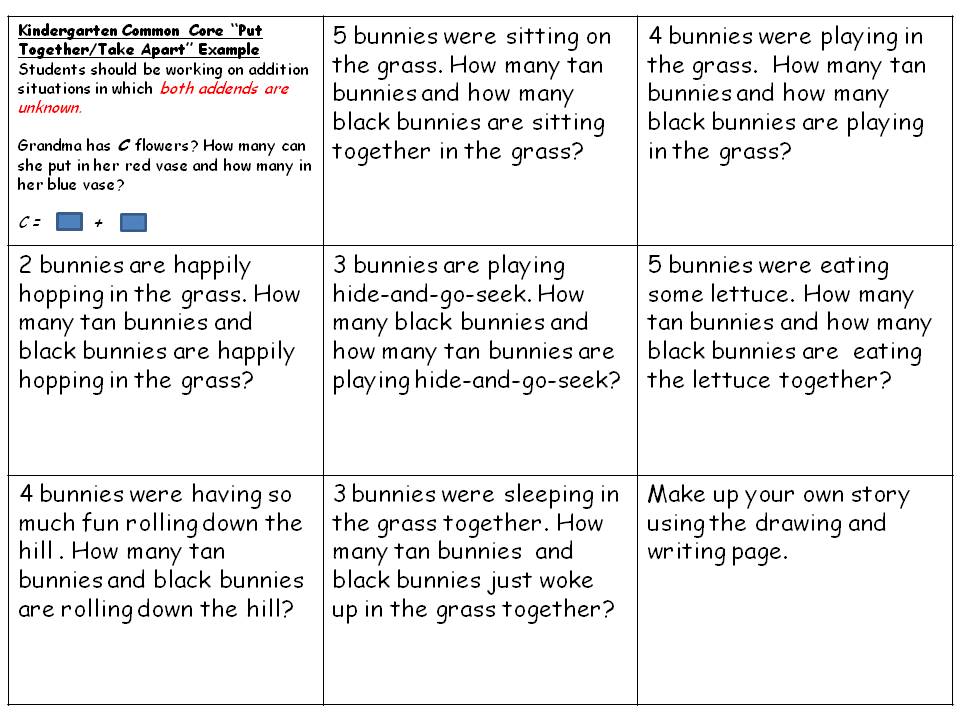
5 pages of Situational Problems Based on the Common Core
Deborah Devine
P.S. It's so darn cute!

Saturday, March 17, 2012

Annie's Bunnies Love to "ADD TO" on the Grass-lined Ten Frame

Here's a fun way to get your students adding sums up to 5 with Annie's Bunnies and the grass-lined ten frame that I created for you. 
I placed two ten-frames on a page so you could cut them apart and save paper. They would be darling printed in color and laminated for the students to use each day during Daily Calendar Time. I also created a set of problems that follow a format suggested by the Common  Core Standards, and can be used with the ten frame.


 One problem could be acted out each day. There is also a writing page that could be used for the students to create their own story.
So...

Click here and go to my Teachers Pay Teachers store for a FREE Download.

Deborah Devine

Monday, June 20, 2011

Addition and Subtraction with 3 Compartment Plastic Plates


In Everyday Math, one of the diagrams used to explain addition and subtraction is the parts-and-whole diagram 

I believe this is a very abstract diagram for students and using a 3 compartment plastic plate and labeling :
WHOLE in the largest Compartment and PART in the two smaller Compartments


really helps students understand the thinking behind the abstract diagram.
Imagine this… you give the students some “Farm Counter “pigs. Then you orally begin the story. A farmer had 2 pigs (they place the 2 pigs in one of the part compartments). He bought 3 more pigs (they place 3 pigs into the other part compartments). How many pigs does he have in all? (They slide the pigs from each of the two PARTS into the WHOLE compartment).  For some reason touching and sliding those pigs around helps student to understand what the story problem is asking them to find.
You can show the relationship between addition and subtraction also. For example: A farmer had 5 pigs (place 5 pigs in the WHOLE compartment) and he sold 3 of them (slide 3 of the pigs into a PART compartment). How many pigs does he have now? (Look in the WHOLE compartment and there are 2 pigs left… so slide them into the other PART as you say…”This is what the farmer had left after selling 3 of his pigs. He has 2 pigs left at his farm.”


Related Posts Plugin for WordPress, Blogger...