Click Here For Free Blog Backgrounds!!!
Blogaholic Designs

Pages

Monday, January 4, 2016

Button Candies Array Cards and the Commutative Property, Lesson 2

The next lesson continues to explore  the
 3 times button candy array cards the 3rd Grader and I 
 made in the last post. (view post)

 
 In preparation for our lesson, I attached a new card to each of the previously made array cards. My plan is to work with the array cards and their related facts
( the Commutative Property of Multiplication).

I created this worksheet.
First, we skipped counted by threes and sixes.
Next, we cut out the candy button arrays for 3 X 6  and 6 X 3, being careful to trim closely to the edge of the buttons.  Before gluing the arrays to the paper, I ask her if she noticed anything the same about the two arrays?
"Yes, I noticed that they are the same size."
"How can you tell?" I asked.
"Well, if you lay one on top of the other you can see they are the same size."
"Yes, they are the same size or we could say they are conquent in shape and contain the same area."


3 X 6 array on top of 6 X 3 array

We summarized our thoughts by filling in the Venn Diagram in the "how they are the same".
We then glued the arrays on the worksheet, and I asked her why she glued them in different directions on the worksheet.
We summarized the conversation by filling in the areas on the "how they are different " on the Venn Diagram.  We also added the corresponding multiplication equation and the repeated addition equation  to each area. We noted that both equations contained the same factors and the same product.


Lastly, the student cut out and glued (on the blue side of the card) the new arrays for each of the related fact multiplication equations.

More lessons on this same subject in the next post....
Smiles,
Deborah


Saturday, January 2, 2016

Button Candies To Teach an Understanding of the Meaning of Multiplication

I've been working with a 3rd Grader to develop an understanding of the meanings of multiplication and division of whole numbers through activities and problems involving equal-sized groups, arrays, and area model.  

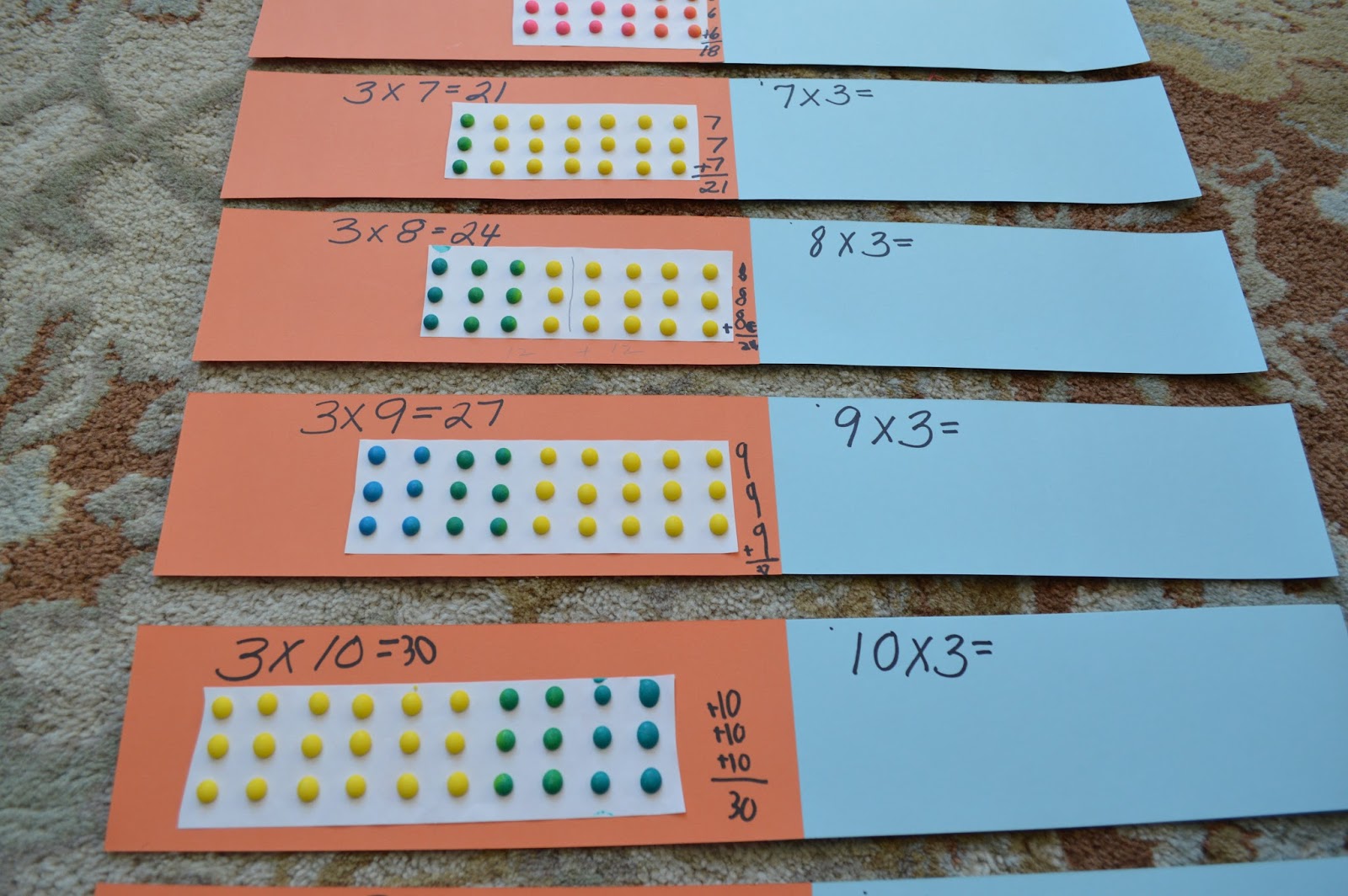
Today we created these flashcards together that illustrate the meaning of the equation.

I like to think of the equation as a sentence. 
 The sentence says, " Three groups of seven are the same as twenty-one."  

When you read the equation in this way, it starts making sense... not just a multiplication fact that you need to memorize.

Notice that we added more meaning by showing the relationship to repeated addition on the left-hand side of the card.
We used this candies to create the arrays.  The 3rd Grader said that it was the yummiest math lesson ever!

When we created the array for the equation 
3 X 0 = 0
I thought the final model really showed the concept:
We peeled the candy buttons and left a residue that showed 
a value of nothing.
Interestingly, when I gave this student a screening test for her multiplication concepts, it showed that she did not understand the concept of multiplying a factor by zero. 
Now I feel that she does understand

The Multiplication Property of Zero

Future lessons will use the cards that we created. 

What do you think of my idea? 

Please share your ideas in the comment section of this post or share a link to your blog in which you are discussing teaching understanding.

Smiles, 

Deborah


Saturday, December 19, 2015

When You Can't Make Connections in Math

Recently, I visited Mexico for a short holiday.  While in Mexico, I experienced that feeling of not comprehending connections about money values.  When I would see a price in a menu, I had no connection to what that amount would be in American money.
I couldn't answer simple questions like:

Should I buy that ceramic glass... is it worth 320 pesos? 
Is this daily rate for my hotel room reasonable and in my budget?
Did that person give me the correct change?
How much is each person's bill at the restaurant and how much should I tip the server?


It was driving me crazy!!!
So I made up a simple chart for my family based on the current exchange rate that looked somewhat like this:
US            Mexico
$1              16
$5               80
$10            160
$15             240
$20             320
ETC.
I also wrote the American value on the end of each Mexican Bill until I started internalizing their value.  Suddenly I felt like I was in control. I had NUMBER SENSE again.

Do you have students in your class that can't make connections between mathematical concepts like fractions, percents, and decimals?    Please help them make those connections with concrete experiences, games, and charts.
Image result for percent, fractions, and decimalsImage result for percent, fractions, and decimals  Image result for percent, fractions, and decimalsImage result for percent, fractions, and decimals   
It feels terrible when you just don't have any connections or background knowledge to help you understand....

Smiles,
Deborah

Sunday, November 1, 2015

6's

Elsewhere on this site, I gave some general times tables tips. Here, we'll have a closer look at the six times tables. You can use this page to show your kids the hidden patterns in the nine times tables, and make it easier for them to learn. Keep in mind that these patterns will mean infinitely more to your children if you can somehow coax them to realize the rule for themselves, rather than just pointing it out to them.
Here's the six times table. By the way, you might like to download the printable six times table chart on this site, and stick it to the wall of your classroom, or your kid's bedroom!
6x1=6
6x2=12
6x3=18
6x4=24
6x5=30
6x6=36
6x7=42
6x8=48
6x9=54
6x10=60
6x11=66
6x12=72

If you have a look at every second row, you might notice an interesting pattern. Inspect carefully the ones digit.
6x1=6
6x2=12
6x3=18
6x4=24
6x5=30
6x6=36
6x7=42
6x8=48
6x9=54
6x10=60
6x11=66
6x12=72

Did you see the pattern?
The ones digit of six times something is the ones digit of the something, at least if the something is even.

What about odd 'somethings'?
6x1=6(and 6-1=5)
6x2=12
6x3=18(and 8-3=5)
6x4=24
6x5=30(and 5-0=5)
6x6=36
6x7=42(and 7-2=5)
6x8=48
6x9=54(and 9-4=5)
6x10=60
6x11=66(and 6-1=5)
6x12=72
There you have it!
For odd 'somethings', the ones digit of six times something is five more or less than the ones digit of the something.

Some other facts about the answers in the six times table :
  • Since the answers are always even, the last digit must always be 0, 2, 4, 6 or 8.
  • If you add the digits together, and do that again and again, you'll eventually get 3, 6 or 9. For example :
    • 6 x 1 = 6...
    • 6 x 2 = 12, and 1 + 2 = 3...
    • 6 x 3 = 18, and 1 + 8 = 9...
    • 6 x 4 = 24, and 2 + 4 = 6...
    • 6 x 5 = 30, and 3 + 0 = 3...
    • 6 x 6 = 36, and 3 + 6 = 9...
    • 6 x 7 = 42, and 4 + 2 = 6...
    • 6 x 8 = 48, and 4 + 8 = 12, and 1 + 2 = 3...
    • 6 x 9 = 54, and 5 + 4 = 9...
    • 6 x 10 = 60, and 6 + 0 = 6...
    • 6 x 11 = 66, and 6 + 6 = 12, and 1 + 2 = 3...
    • 6 x 12 = 72, and 7 + 2 = 9...
    Amazingly, this pattern, 6,3,9,6,3,9,... continues forever.
    • 6 x 5468 = 38208, and 3+8+2+0+8=21, and 2+1=3...
    • 6 x 5469 = 38214, and 3+8+2+1+4=18, and 1+8=9...
    • 6 x 5470 = 38220, and 3+8+2+2+0=15, and 1+5=6...
    • 6 x 5471 = 38226, and 3+8+2+2+6=21, and 2+1=3...
    • 6 x 5472 = 38232, and 3+8+2+3+2=18, and 1+8=9...
How's that for an interesting pattern?
Before I close this page, if your child can easily multiply by 5, or by 2 and 3, there are a couple of easy ways to multiply by 6.
  • 6 times something is twice 3 times something. So if I want 6 times 9, I can say 3 times 9 is 27, then 27+27 is 54. Not easy for every kid, but maybe it'll work for yours.
  • Probably, it's easier to use this trick : 6 times something is 5 times something, plus another something. So to work out 6 x 7, I'd remember 5 x 7 is 35, then add another 7 to get 42. Or to find 6 x 12, I'd remember 5 x 12 is 60, then add another 12 to get 72.

Monday, August 3, 2015

Opinion Writing as a Response to "Junie B. Jones Is Not a Crook"


Using the book, Junie B. Jone Is Not A Crook,  I wrote a reader response to the question: If you saw something in the Lost and Found at school would it be okay to take it?

You are welcome to copy my idea, or you can purchase all the needed pages so your students can create the fan book themselves, in my Teacher Pay Teacher store. They are having a 10% off sale today and tomorrow. This item is only $1.99 in my store.
The unit includes the fan template in two formats: lined and unlined. In addition, 2 activities are also included: 
1) Whole Group Oral Activity To Work on Adding Reasons to Support Their Opinion
 2) Supporting Your Opinion with Good Reasons from your Schema or Personal Experience. 

Check it out by CLICKING HERE

Created to address the following Common Core Standards:
CC.3.W.1  Write opinion pieces on familiar topics or texts, supporting a point of view with reasons.
CC.3. W. 1.a   Introduce the topic or text they are writing about, state an opinion, and create an organizational structure that lists reasons.
CC.3.W.1.b   Provide reasons that support the opinion
CC.3. W.1.c   Use linking words and phrases (e.g., because, therefore, since, for example) to connect opinions and reasons.
CC.3.W.1.d    Provide a concluding statement or section.

Let me know what you think about the fan book in the comment section of this post.  I read everyone of your comments and respond to your questions.
Smiles,
Deborah

Friday, July 10, 2015

Eureka Math Taught in Guided Math Groups

I'm going to a Eureka Math Training at the end of the month. 

Has anyone used this curriculum in a Guided Math Format? 
 Please leave me a comment as I would love to hear how it worked...
I've also been considering how to use it with
 Multi-grade/Split  Classes.

Smiles,
Deborah

Monday, June 29, 2015

Opinion Writing for a Multi-Grade Classroom: Conclusion

I've been working on a unit for 3rd, 4th, and 5th Graders about Opinion writing based on the Common Core Writing Standards.

  My goal is to create a unit that can be used in a
 Multi-Grade Classroom. 
 Here's an example of one of the activities.


To make it work for a Multi-Grade classroom, there are 3 different paragraphs that are appropriate for different grade levels. 

 The whole class has a mini-lesson about writing a conclusion to an opinion paragraph.   The teacher then divides students into small groups, and that group receives one paragraph based on their reading level.

Smiles,
Deborah
Related Posts Plugin for WordPress, Blogger...