Click Here For Free Blog Backgrounds!!!
Blogaholic Designs

Pages

Saturday, November 30, 2013

December Calendar

Here's my suggestion for the December Calendar:


Why little boys in red and green?  Well red and green are colors well know for their use in December.

Why little boys?  I chose them because you can practice counting by 2's.

For example
  How many eyes do the 5 boys have? "Let's count by two's."
  How many ears do the 9 boys have? "Let's count by two's ."
  If each boy hopes to receive 5 gifts on Christmas, how many gifts in all would they receive?
  If each boy does 10 kind acts, how many acts of kindness would happen this month so far?
  If each red boy has 2 sisters, and each green boy has 1 sister how many sisters would they have. (on December 15th)

When you have little boys, it's easy to come up with problem solving situations for the group to solve.

Deborah

Tuesday, November 19, 2013

Learning About Time: Half Past

Recently I was working with a First Grader about the concept of "Half Past."  She understood why it was called half, as I had her walk around a large clock model made from a round vinyl tablecloth and she could see that she was halfway around the clock circumference.  But she continued to struggle with the "past " idea.

Then it hit me...maybe she doesn't really know what the word "past" means.

So here is what I did:
I lined up five stuffed animals in a row.  As I walked past a short distance I would look back at each animal and say, "I'm past the zebra. I'm past the lion...and so forth."

Then I had her repeat the walk and say when she had past each animal.  Suddenly she said, "Oh, that's why you say the number that the short hand has already gone by." 

Then I gave her a "Hour Hand" made out of a paint stick.   Each time she was halfway between two animals, she was directed to say, " I'm half past the name of animal."  Together these activities made it all click for her. 

By the way, she also told me that "half past" and "thirty" mean the same thing, AND THAT PUT A BIG SMILE ON MY FACE!

DEBORAH 


Monday, November 11, 2013

November Ten Frames Demonstration Cards

I made these special "Scarecrow Demonstration Ten Frames" for you from 1-20.


These are some examples of the demonstration 10 Frame Cards.

If you download a copy for yourself HERE, please leave a comment that explains
one way that you plan to use them.  I am hoping to generate a list of different ways teachers are using 10 frames in their classroom.

Deborah

Saturday, November 2, 2013

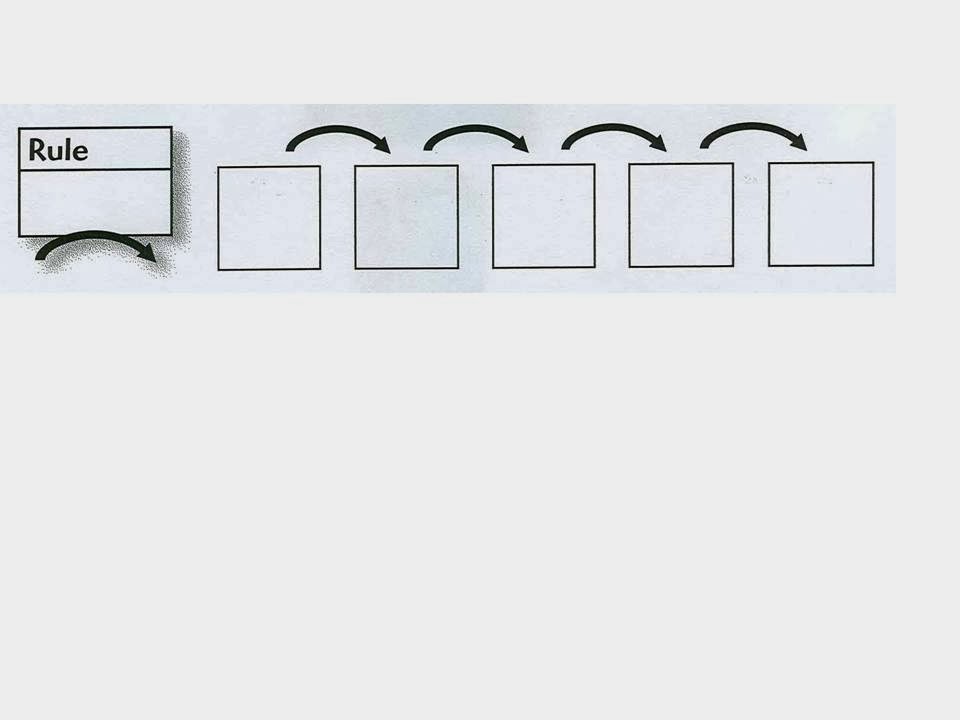
Frames and Arrows Template from Everyday Math

Frames and Arrows are the beginning of a Function Table.

 The student is applying the "rule."  To me the big important idea is the fact that the number is "changing"  to fit the rule or mathematicians would say that they have a relationship.
  So when I introduce the rule, I start be making it a concrete experience.

I start with a large mat that I traced onto a piece of vinyl fabric or rolled bulletin board paper, using an overhead projector. This is the image that is traced:


The student steps on the mat at the "In" and is wearing a coat.  The rule is: Add 1 mitten.
Therefore, when they step out of the rule box they now have a coat + 1 mitten on.

  The next student steps into the rule box one the "In" and is given the rule. The rule is: Add 1 hat.
  Therefore, when they step out of the rule box they now have a coat + 1 hat.

A Class discussion follows ABOUT HOW THE RULE EFFECTS THE STUDENT WHEN THEY ENTER THE IN AND EXIT THE OUT. The effect is not always the same.
  

Next, I have the student with the coat + 1 mitten enter the "In" and receive the +1 mitten rule. I ask the students to predict what will happen  when the student steps "Out" of the box. 
 The student will have 1 coat and 2 mittens.

The next student with 1 coat + 1 Hat enters into the box and receives the rule +1 mitten.
Next, the students predict what will happen.
The student will have 1 coat, 1 hat, and 1 mitten.

Now introduce a mat that looks like this:
The rule is add 1 mitten.
Begin by drawing a picture of 1 mitten over the top of each arrow.

Student stands on the first box with 0 mittens.
The second box= student with 1 mitten.
The third box = student with 2 mittens.
The fourth box = student with 3 mittens.
The last box = student with 4 mittens.

Next make the rule +2
Begin by drawing "+2" over the top of each arrow.

Student stands on the first box with a dry erase board on which you have written "3".
The second box = erase 3 and write the number 5.
Ask the students why they think that you changed the number from 3 to 5.
The third box = erase 5 and write the number 7.
Ask the students why they think that you changed the number from 5 to 7. 
(You applied the rule of +2 )
Continue onto the fourth and fifth boxes.

Now you have taken an abstract template and made it understandable to your students.  

In First Grade, you might leave the words "in and out," or if your students are ready, you can add...

 input and output

So what do you think about my idea to make the frames and arrow template more understandable?
Please share your thoughts.

Smiles,
Deborah


Friday, October 25, 2013

Money and the November Calendar Routine


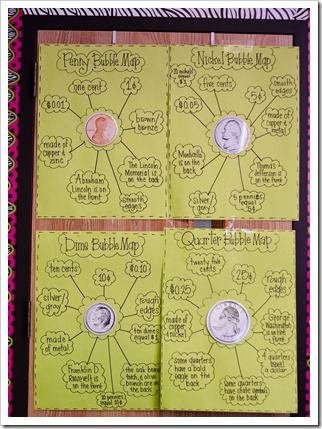
Here is my suggestion for calendar time for the month of November:  Create a pattern of coins. 
 
As each new coin is introduced, a new piece of information can be discuss about that particular coin. I used plastic money and just double-stick taped it to the laminated calendar.


As different information is discussed about each coin, an anchor chart can be created like this one from First Grade Parade blog:

valentinesday5

So what do you think about my idea?  Leave a comment...

Thursday, October 24, 2013

Even and Odd

Why do many teachers only teach examples of even and odd numbers, and not properties of even and odd numbers?

What do I mean?  Well, this is what I discussed with a 1st Grade Student when the only thing she could tell me about even and odd numbers was:
Even is 2, 4, 6, 8, and 10
Odd is 1, 3, 5, 7, and 9
And that's all....

First, we built models of the numbers 1 through 10

Then I asked her 2 separate the models into 2 groups that were alike in some way.

This is how she separated the models.  When I asked her what she noticed about the two groups, and she noted this on the models:

"This group doesn't have a partner for each part of the number
and this group does have a partner.  See, how I circled the partners."

Then we discussed how certain numbers can be divided into groups of two, and that we call those numbers Even Numbers.

We went on to talk about odd numbers too.  Since she is in a dual language class, she also wanted to write the Spanish word for even/par and odd/impar on the model.

Next, I asked her to now tell me what she knows about even and odd numbers and she wrote this:
I found it interesting that she put an arrow after the numbers and said "and on and on."  (That put a smile on my face.)

So we talked about how you look at the "on and on numbers" in the ones place to see if they are even numbers or odd numbers. 

I evaluated her knowledge by quickly using a set of teen number cards.
and asked her to classify them as even or odd numbers. 

She was correct, and we even checked our first answer to
 prove that she was correct.

Deborah


Sunday, October 6, 2013

"Because"

When I taught 2nd, 3rd, and even 4th Grade Classes, I was always surprised how many students could not spell the word "because."


SO..... how about changing the computer log-in password that your students must use to  "because." This just might be the perfect way to make sure all of your students learn the correct spelling of this important word. What do you think about that idea?

Deborah
Related Posts Plugin for WordPress, Blogger...